Charlotte Mason Copywork: What It Is and Why It Works

I’m a classical homeschooler, but copywork is something I borrowed straight from Charlotte Mason, and it’s become my favorite part of our school day.
Whether you follow Charlotte Mason, a classical curriculum, a hybrid curriculum, or something in between, this practice is worth adding to your homeschool. I’m going to show you why and explain exactly what copywork is.
See also my article on teaching cursive: How to Teach Cursive the Charlotte Mason Way

Save This Page
What Is Copywork?
Simple: your child copies a passage of well-chosen text by hand. A sentence, a verse, a short paragraph. That’s it.
That might be:
- a Bible verse
- a line of poetry or a whole poem
- a proverb
- a sentence from classic literature or a longer excerpt
- a catechism answer
- a hymn
- a wise saying
The practice is genuinely ancient. Archaeological evidence from Greek and Roman schools shows teachers writing a model at the top of a wax tablet for the child to copy below.
Quintilian, whose Institutio Oratoria is one of the most detailed records we have of Roman education, describes children tracing and copying letters as the foundation of writing instruction.
Copywork was also standard in American schools through the 18th and 19th centuries before being largely set aside in the 20th.
Charlotte Mason brought it back into focus — or kept it alive, depending on who you ask.
Why Charlotte Mason Copywork Works
The classical argument is straightforward: imitation precedes original composition. You fill the well before you draw from it.
A child who has spent years copying great authors has something to draw from when she eventually sits down to write her own sentences — rhythm, structure, an instinct for how good prose is built. It accumulates quietly and surfaces later, often in ways that surprise you.
Charlotte Mason called it transcription, and the practical benefits compound daily.
Handwriting develops through slow, careful repetition rather than drills divorced from real content.
Spelling is absorbed by looking closely at words in context, not memorizing lists. Mason even suggested having children study a word, picture it with their eyes closed, then write it from memory — a natural bridge toward dictation.
Grammar and punctuation are internalized from real sentences. When a child copies a passage of dialogue, she encounters quotation marks doing actual work — not abstracted onto a worksheet.
A feel for good writing , the hardest to measure and probably the most valuable. By the time formal composition is introduced, a child who has done years of copywork isn’t starting from nothing. The language is already inside him. She grasps it faster because it isn’t foreign.
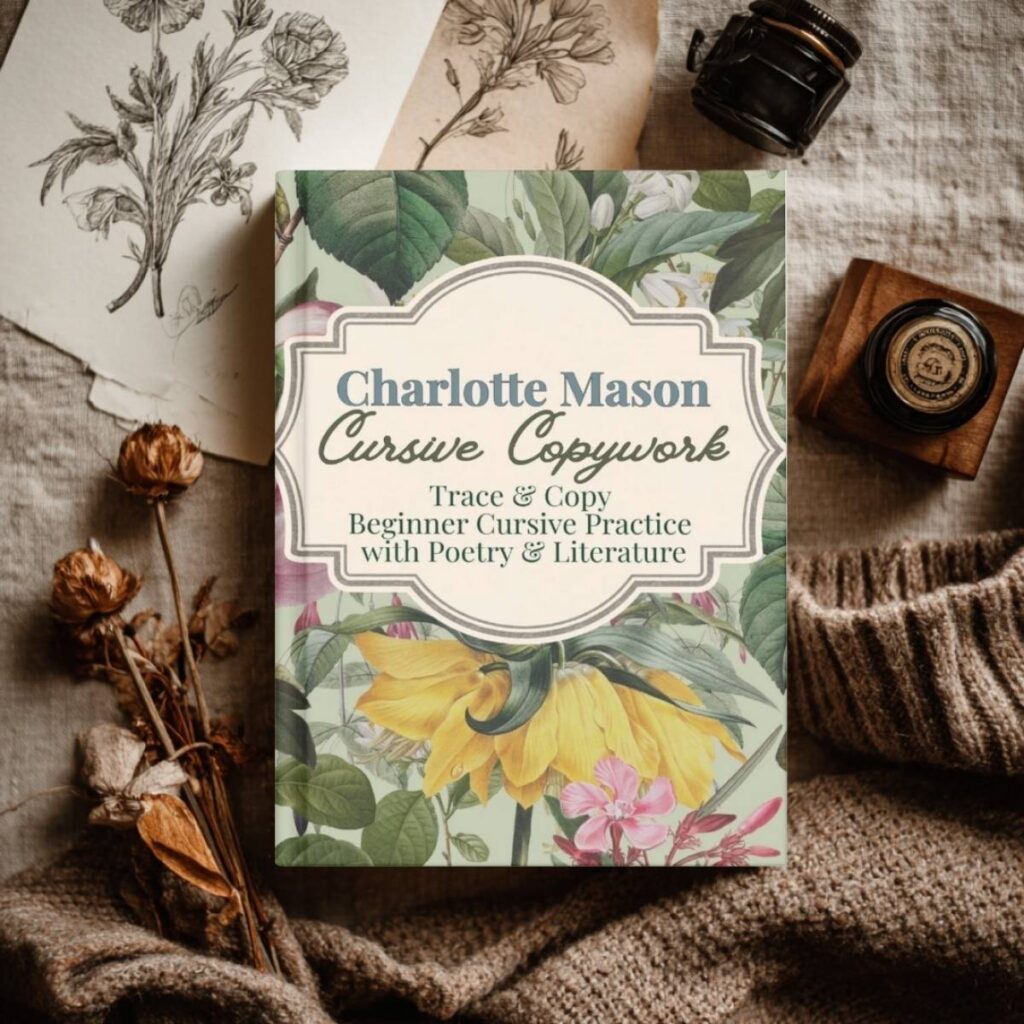
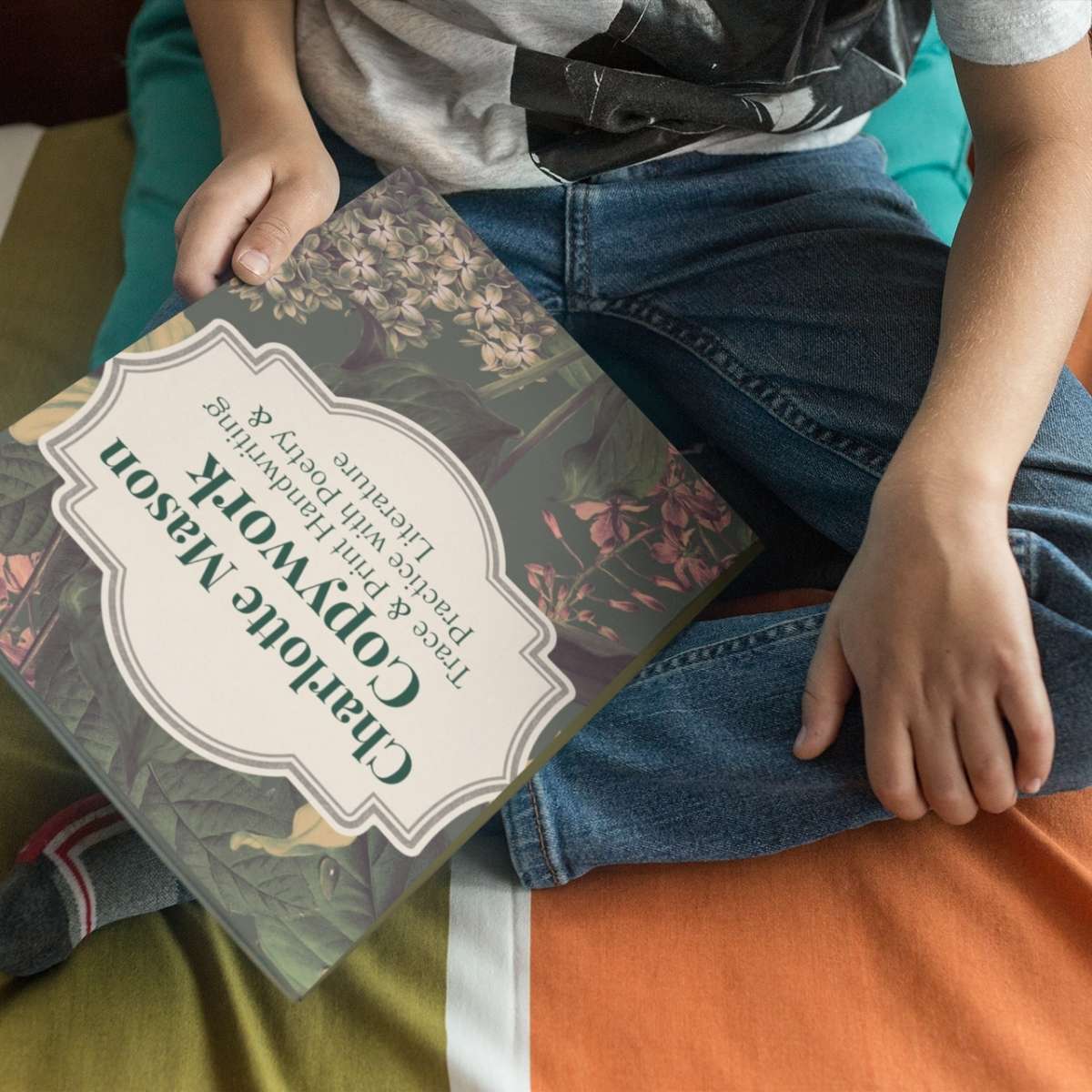
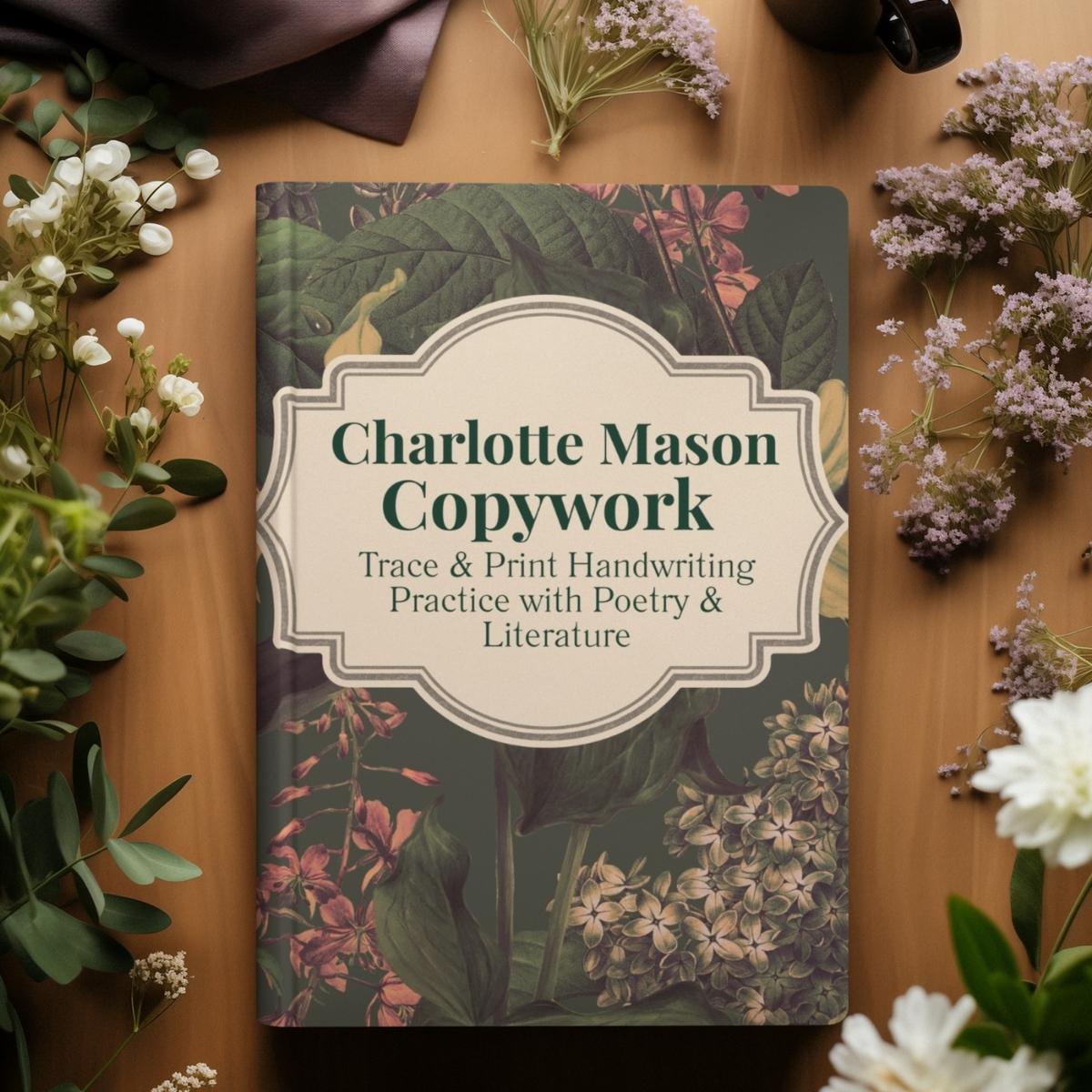
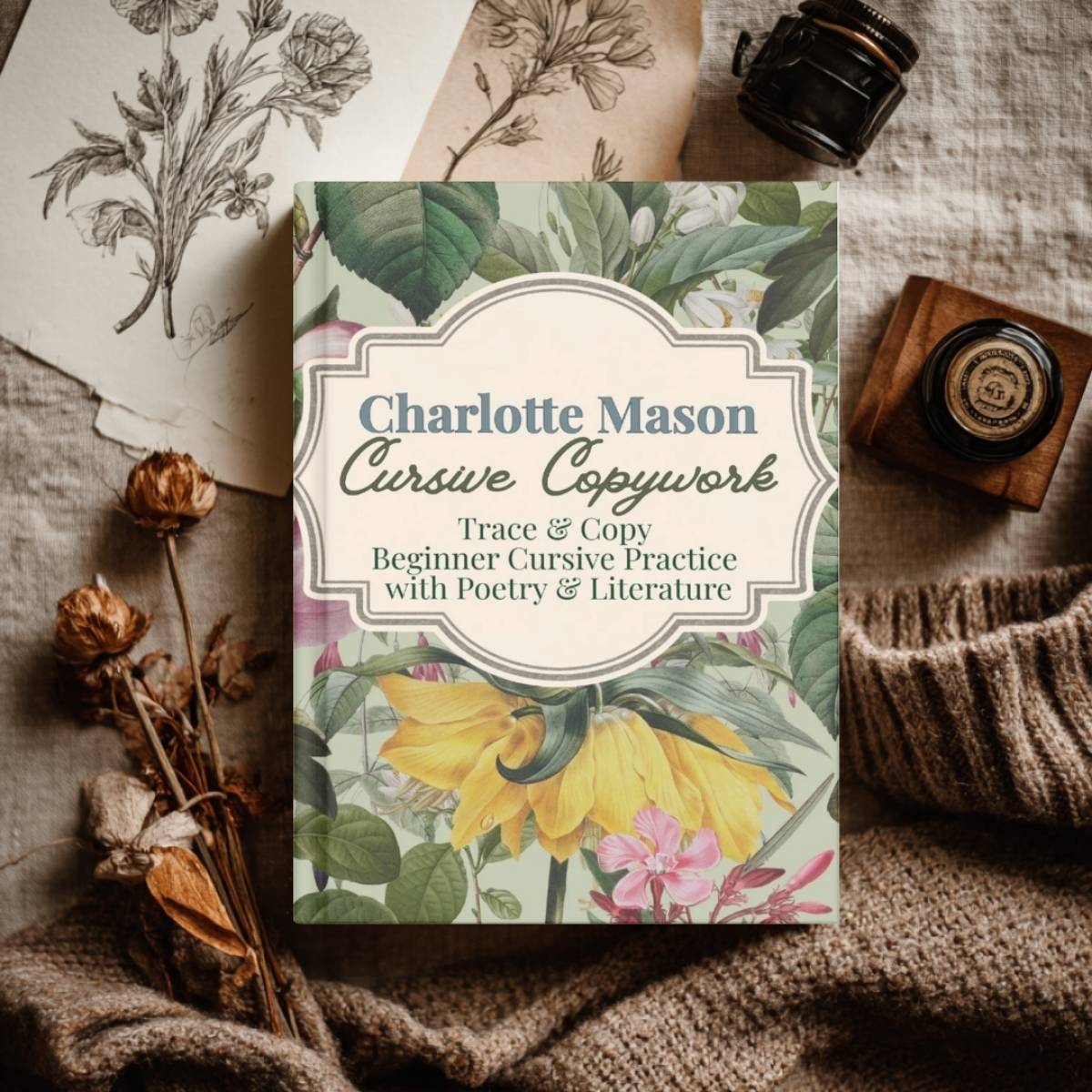
I became so passionate about this that I started creating my own workbooks filled with poetry and literary passages from classic children’s literature that my children loved hearing. This seems like a natural progression for a classical homeschooling mom with an English Lit. degree who is also passionate about education, especially traditional forms of it. You can find them below and buy them if you wish.
How Charlotte Mason Viewed Copywork
On the Purpose of Copywork:
“The earliest practice in writing proper for children of seven or eight should be, not letter-writing or dictation, but transcription, slow and beautiful work…”
On Quality Over Quantity:
Charlotte Mason did not recommend long handwriting sessions for young children. She preferred short lessons done well.
“Not more than ten minutes or a quarter of an hour should be given to the early writing-lessons. If they are longer the children get tired and slovenly.”
On Spelling Through Copywork:
“Transcription should be an introduction to spelling. Children should be encouraged to look at the word, see a picture of it with their eyes shut, and then write from memory.”
On Choosing Beautiful Material:
I find the following to be so very true of my own son, who, at 5 1/2 (as of this writing), loves copywork and has an immense sense of pride in his ever-improving penmanship. He often asks to keep going.
“A certain sense of possession and delight may be added to this exercise if children are allowed to choose for transcription their favourite verse in one poem and another.”
On Perfect Execution:
“The child should feel the accomplishment of succeeding in a task.”
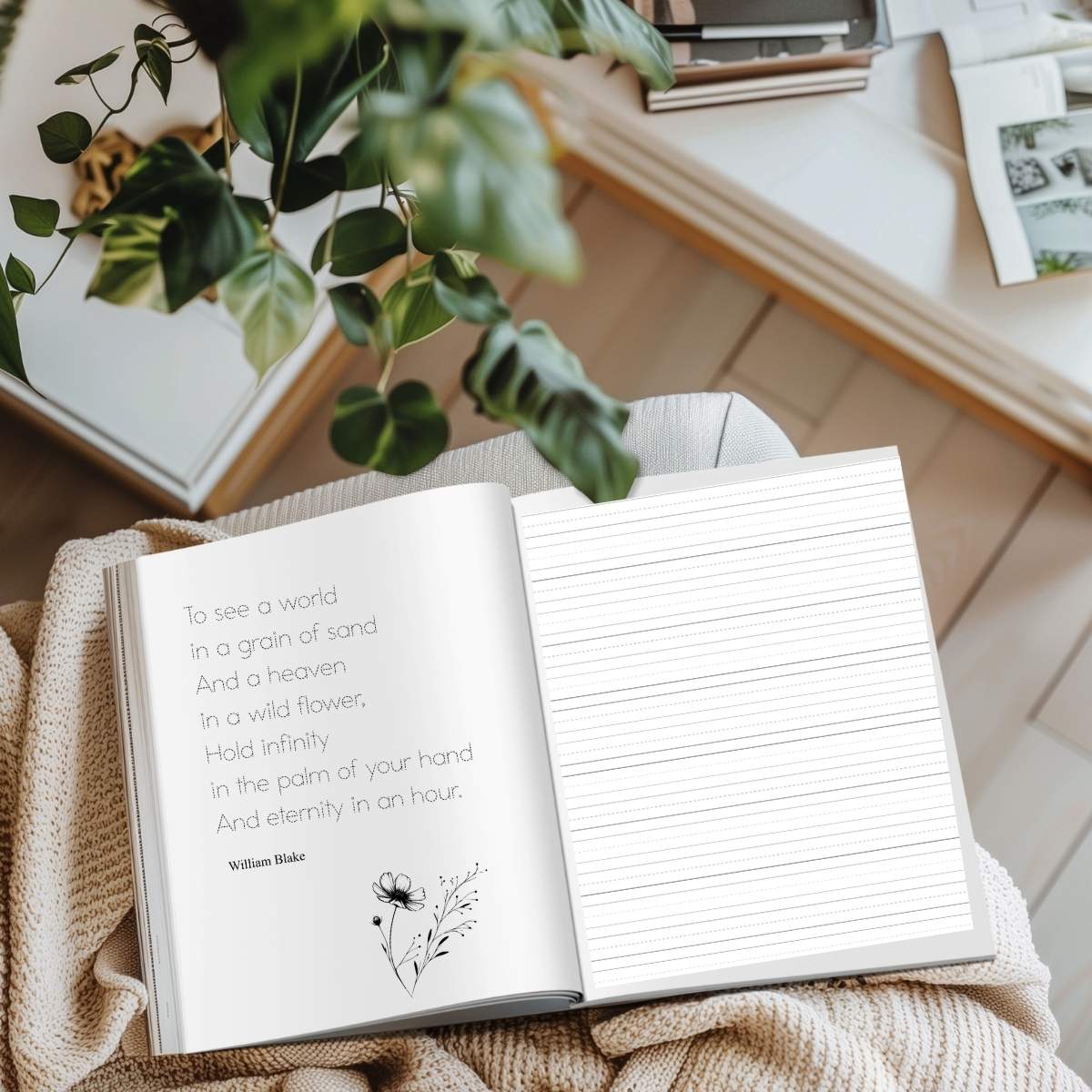
A Charlotte Mason Transcription (Copywork) Lesson, Reconstructed from Home Education
Charlotte Mason gave enough practical instruction that we can see how the lesson was meant to work. It was short, careful, and tied closely to spelling, attention, and beautiful handwriting.
Mason wrote:
“The earliest practice in writing proper for children of seven or eight should be, not letter-writing or dictation, but transcription, slow and beautiful work…”
So for a younger child, the passage should be very short. A sentence, a line of poetry, a proverb, or a brief Scripture verse is plenty. The child is not filling pages. He is learning to give his full attention to a small amount of work and do it well.
Mason also connected transcription directly to spelling:
“Transcription should be an introduction to spelling. Children should be encouraged to look at the word, see a picture of it with their eyes shut, and then write from memory.”
This is one of the parts of her method that gets missed. *The child should not simply copy letter by letter with no thought. He should look carefully at the word first, notice its shape and spelling, hold it in his mind, and then write it. Even one difficult word can be treated this way before the whole sentence is copied.
A simple lesson might look like this:
- Choose one short, worthy sentence.
- Read it aloud together.
- Notice any difficult spelling, capital letters, or punctuation.
- Have the child look carefully at one tricky word, close his eyes, and picture it.
- Let him copy the sentence once in his best handwriting.
- Stop before he becomes tired and careless.
Mason was clear that early writing lessons should not drag on:
“Not more than ten minutes or a quarter of an hour should be given to the early writing-lessons. If they are longer the children get tired and slovenly.”
That last word is useful. She was not trying to squeeze as much handwriting as possible out of a child. She wanted the child to build the habit of careful work. Once the work becomes tired and sloppy, the lesson has already gone too long.
For a six- or seven-year-old, one carefully copied sentence may be enough. For an older child, it might be a few lines of poetry or a short paragraph from literature. The principle is the same: short, attentive, accurate work from words worth copying.
How We Do It
Short lessons of ten or fifteen minutes, sometimes less. Mason’s standard was that the work should match the model, and if it clearly doesn’t, the child tries again. Not as punishment. As a natural consequence. The habit of doing things properly is worth building early.
Where we diverge from Mason is worth being honest about.
She placed transcription at ages seven or eight — her own words in Home Education are that it is “the earliest practice in writing proper for children of seven or eight.”
I started my son at five.
She also begins by copying capital letters from a visible model, without tracing. I still do letter formation drills: he traces a line of uppercase letters, copies them, then traces a line of lowercase letters and copies them.
I find the tracing builds penmanship in a way that jumping straight to copying doesn’t, as the repetition cements proper formation before bad habits set in.
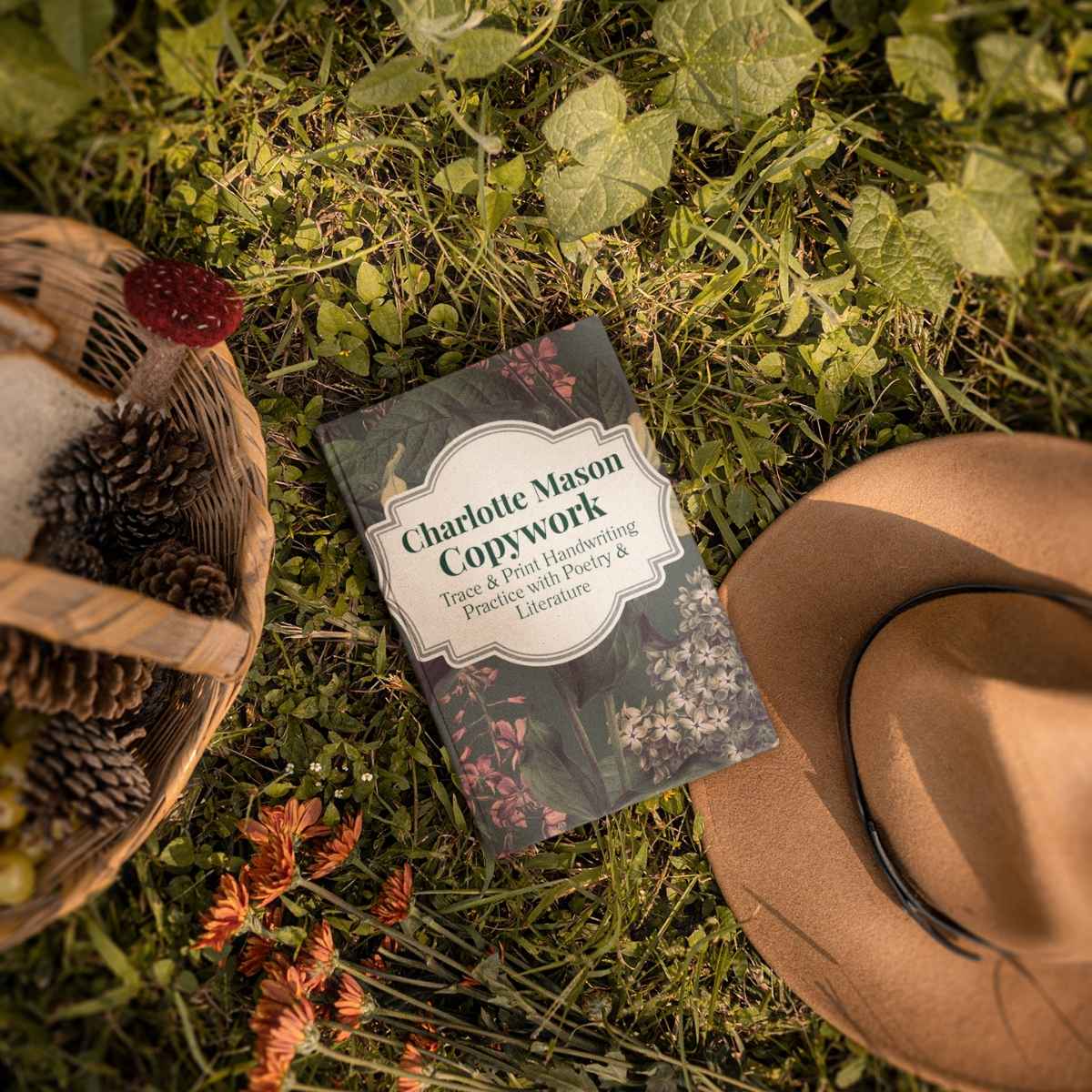
This is exactly why I designed my workbooks the way I did. Each passage is presented in trace lines with blank lines on the adjacent page, with a dotted midline. The lines are the appropriate height for a beginner in the first book, but they become smaller in the second, more advanced workbooks for both print and cursive.
The tracing is optional, and plenty of families skip it entirely and go straight to copying, which is fully in line with Mason’s method. But it’s there if you want it.
As the child advances, the same passages work well for dictation too, so the books stay useful longer than you might expect.

The passages are drawn from authors worth spending time with: Robert Louis Stevenson, Christina Rossetti, Shakespeare, Tennyson, A.A. Milne, Aesop, Tolkien, C.S. Lewis, and others.
The beginner printing handwriting edition is available now for ages 5–10, and if your child is ready for cursive, that cursive edition is available as well. Two more volumes for older children and more advanced writers are in the works. I also have my comprehensive cursive workbook available, which incorporates copywork into it.
Copywork rewards you slowly. One day, you notice your child writing with an ease and a sense of rhythm you never explicitly taught. I’ve seen my son’s pride and confidence in his handwriting improve drastically each week, and I’m so thankful I introduced copywork into my homeschool.
If you want to give your child that foundation without having to source and format passages yourself, my workbooks are a great start and ready when you are.