How to Teach Cursive the Charlotte Mason Way

Teach cursive the Charlotte Mason way. What script did Charlotte Mason actually recommend for handwriting? How her method works in practice, and how we teach cursive in our classical homeschool using traditional cursive copywork.

Save This Page
How to Teach Cursive the Charlotte Mason Way
If you have been doing copywork with your child for a while and print is starting to feel settled and natural, you are probably thinking about cursive. Most homeschoolers make this transition somewhere between ages 7 and 10. When do you start? How do you introduce it without undoing the good habits you have already built?
The Charlotte Mason approach to cursive is worth understanding properly, because it is actually quite different from what most of us picture when we think of handwriting instruction.
(New to copywork? Start with Charlotte Mason Copywork: What It Is and Why It Works first.)
Charlotte Mason’s Handwriting Progression
Mason’s framework builds in a clear arc, and understanding it makes the transition to cursive make much more sense.
Before age 6: formal lessons have no place. Mason did allow for playful letter familiarisation in the early years, provided it remained entirely child-led. Her standard was clear: “There is nothing against it so long as the finding and naming of letters is a game to him. But he must not be urged, required to show off, teased to find letters when his heart is set on other play.” (Home Education, p. 201-202). A sand tray, wooden letter pieces, tracing in the air are all appropriate at this stage. Play and interest, never pressure.
At age 6: formal handwriting lessons begin. Mason’s standard was exacting: “First, let the child accomplish something perfectly in every lesson: a stroke, a pothook, a letter. Let the writing lesson be short; it should not last more than five or ten minutes. Ease in writing comes by practice; but that must be secured later. In the meantime, the thing to be avoided is the habit of careless work: humpy m’s, angular o’s.” (Home Education, p. 233-234)
At ages 7 or 8: transcription (copywork) begins. In her own words: “The earliest practice in writing proper for children of seven or eight should be, not letter writing or dictation, but transcription, slow and beautiful work.” (Home Education, p. 238). This is where handwriting and language arts merge. The child is no longer practicing letters in isolation but copying real prose and poetry, slowly and beautifully.
The principle throughout is the same: correctness first, speed later, short lessons always.
Is Your Child Ready for Cursive?
The honest marker is readiness rather than a birthday. A child is ready for cursive when print letterforms are consistent and correctly formed, when she can copy a short passage without her hand fatiguing quickly, and when letter sizing and spacing are reasonably controlled. A child pushed into cursive before print is solid might struggle with both.
For most Charlotte Mason homeschooling families, this falls naturally out of the copywork habit. A child who has been doing daily transcription for a year or two arrives at cursive with her hand already trained. You are teaching a new form, not a new skill.
If your child is just beginning cursive and you want a dedicated step-by-step beginner resource, that is a separate issue and article. This article is focused on the Charlotte Mason cursive copywork approach, specifically for children who have print under control and are ready to move into cursive through meaningful passages.
My Copywork Workbooks
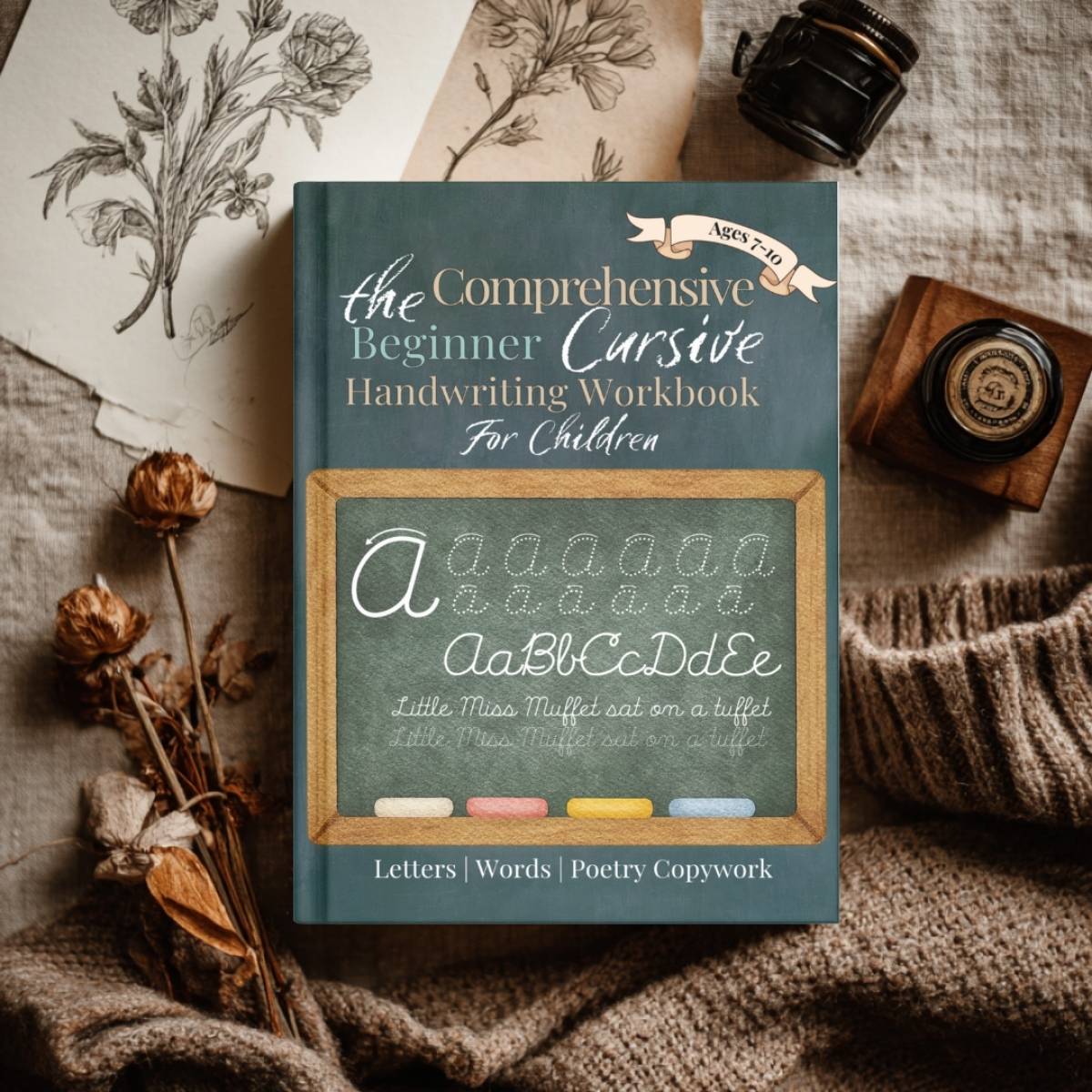
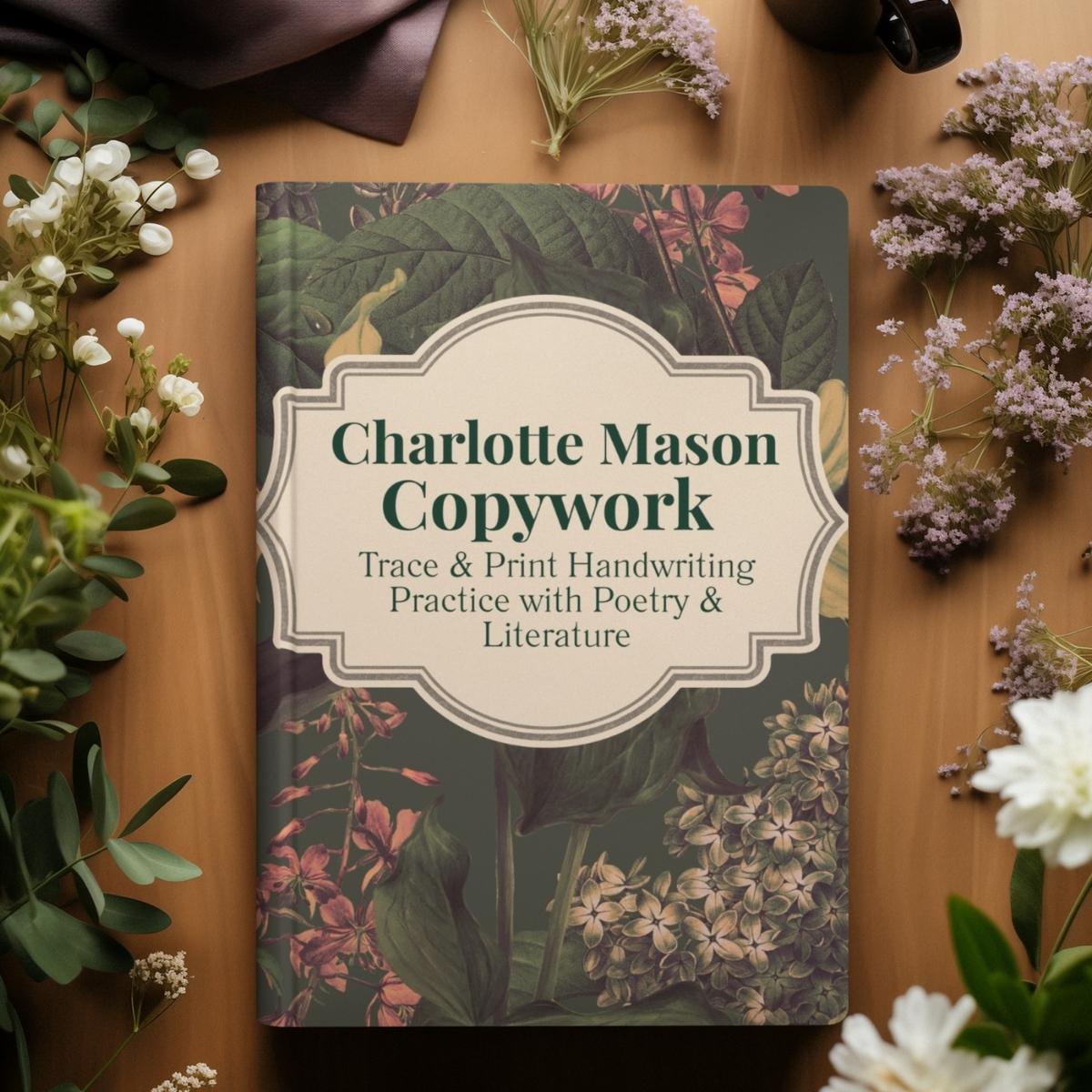
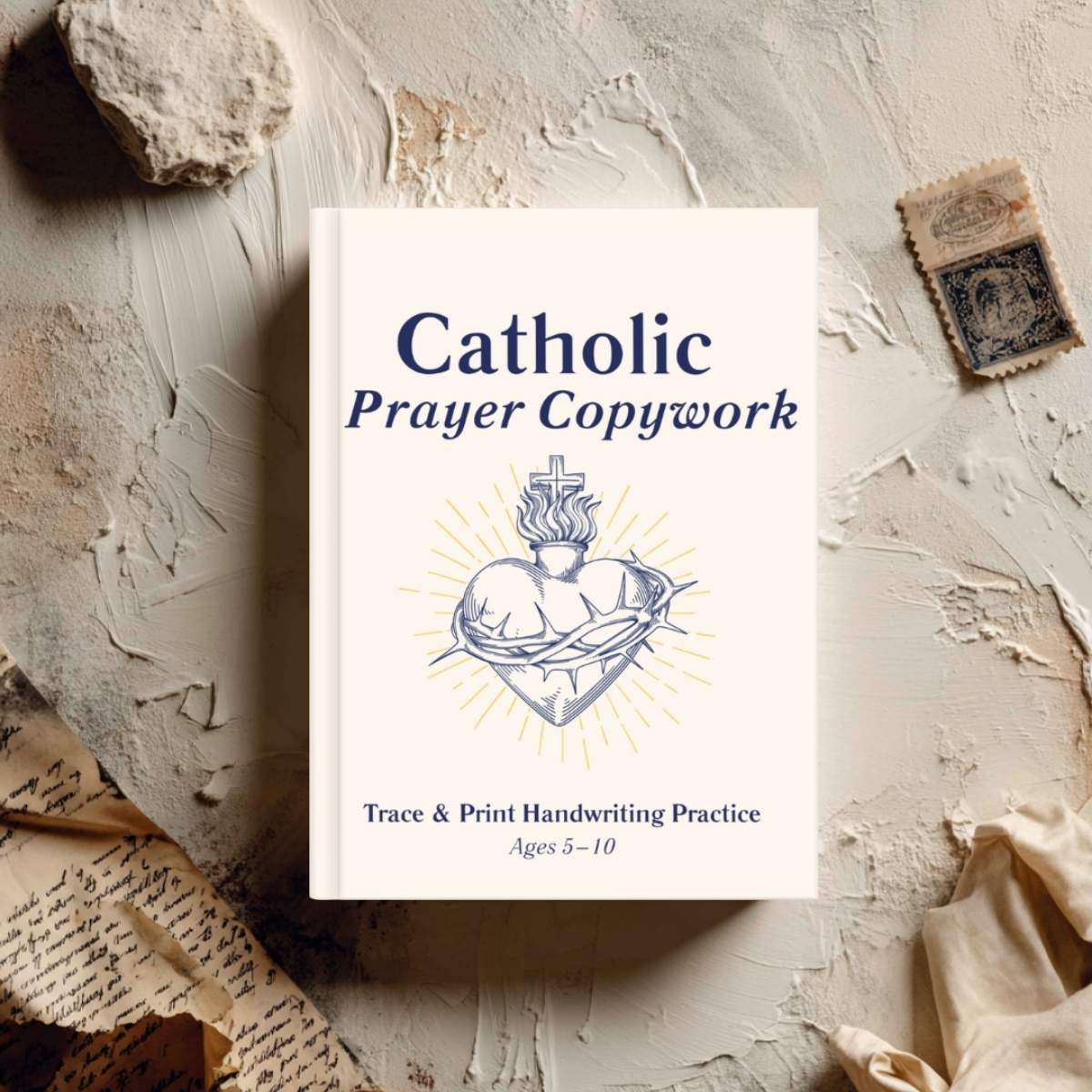
How to Teach Cursive Handwriting the Charlotte Mason Way
The method mirrors what Mason prescribed for copywork: back up to the foundations before moving into passages.
For cursive, that means starting with the foundational strokes before attempting full letters. The undercurve, the overcurve, the slant stroke are to cursive what pothooks were to print. A child who practises these first forms the joins correctly from the start rather than developing habits that are difficult to undo later. One letter at a time, practiced until it is consistently well formed before moving to the next.
Once letter formation is established, Mason’s approach was to move directly into meaningful passages without extended drills. The letter practice is a runway, not the destination. Get through it and into real copywork as soon as the hand is ready.
Lessons stay short. Five to ten minutes. Quality over quantity, the same as always.
How We Teach Cursive in Our Homeschool
Mason’s own recommended script was an italic cursive, used from the very beginning rather than as a separate stage after print. Most modern homeschooling families, including ours, don’t follow that path. We use a conventional print-then-cursive sequence, which is a practical choice: standard print integrates easily with other curricula, and the transition to cursive is straightforward when print habits are already solid.
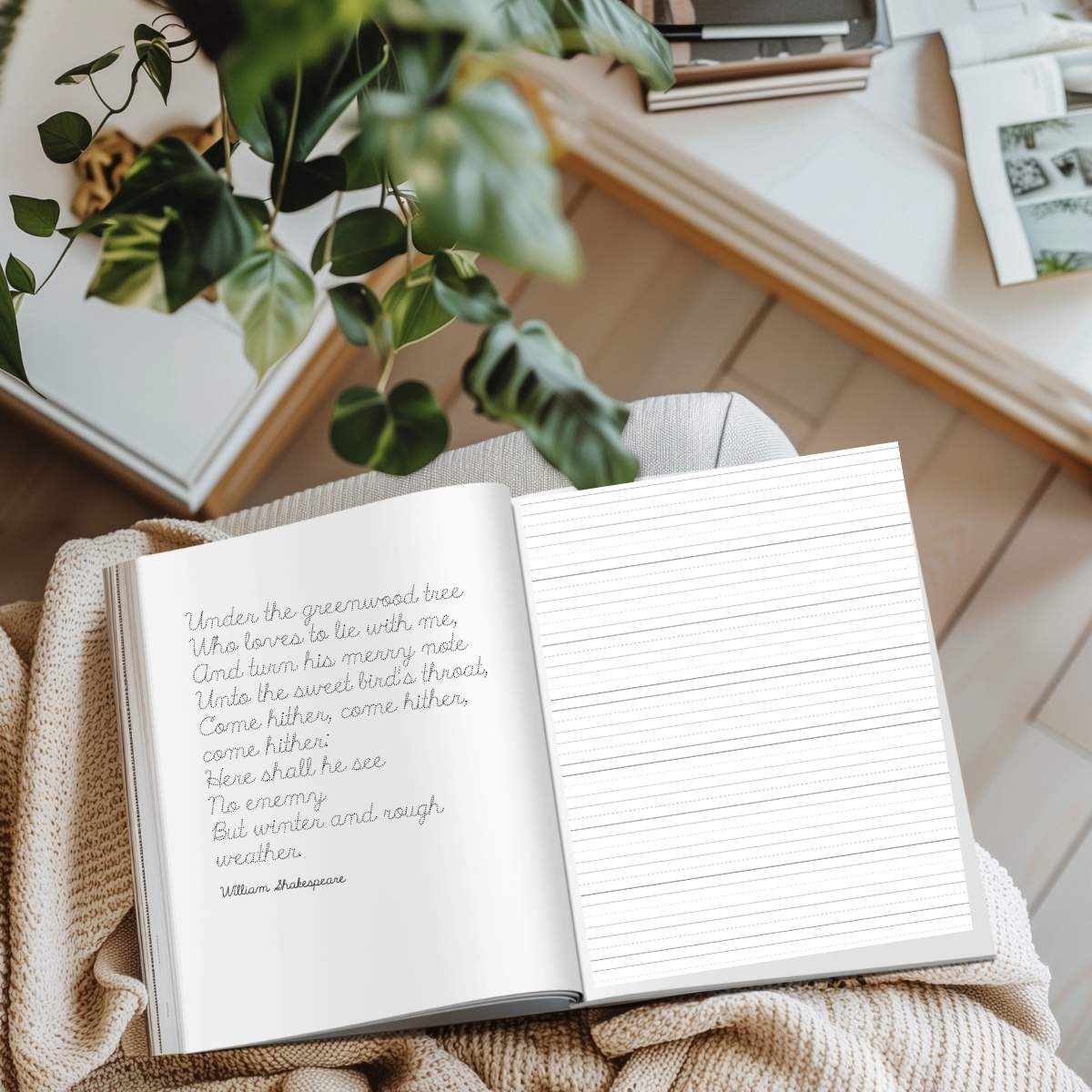
I started my own children on print at age 5, younger than Mason recommended, and created workbooks full of beautiful classic poetry and literary prose with (optional) tracing pages in the workbooks. Mason did not use tracing, but I find it builds penmanship in the early stages and cements correct formation before bad habits develop.
What stays entirely faithful to Mason is everything that matters most: short lessons, best effort, a good model, and meaningful passages worth copying. Those principles hold regardless of which script or sequence you use. The script choice is secondary to the habit.
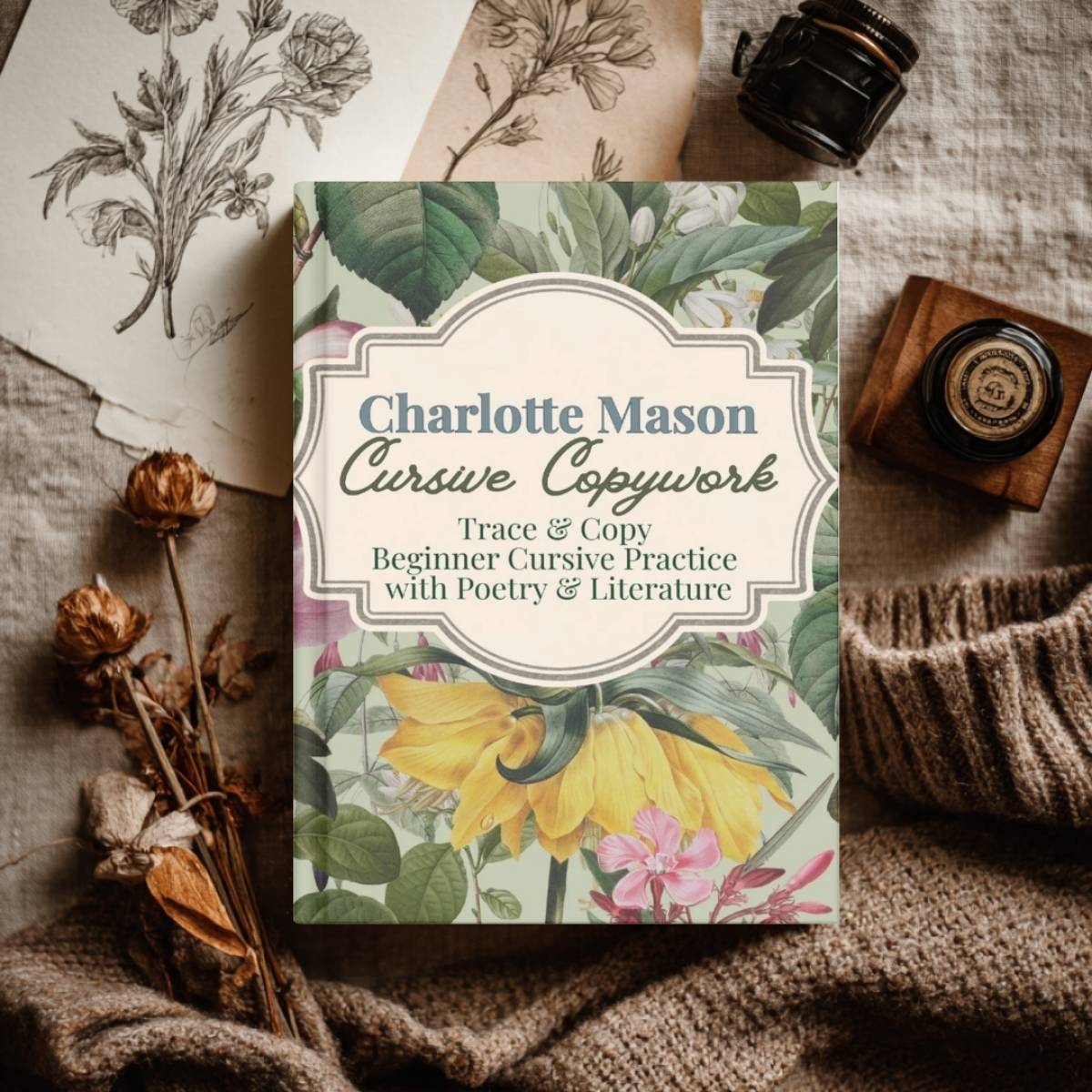
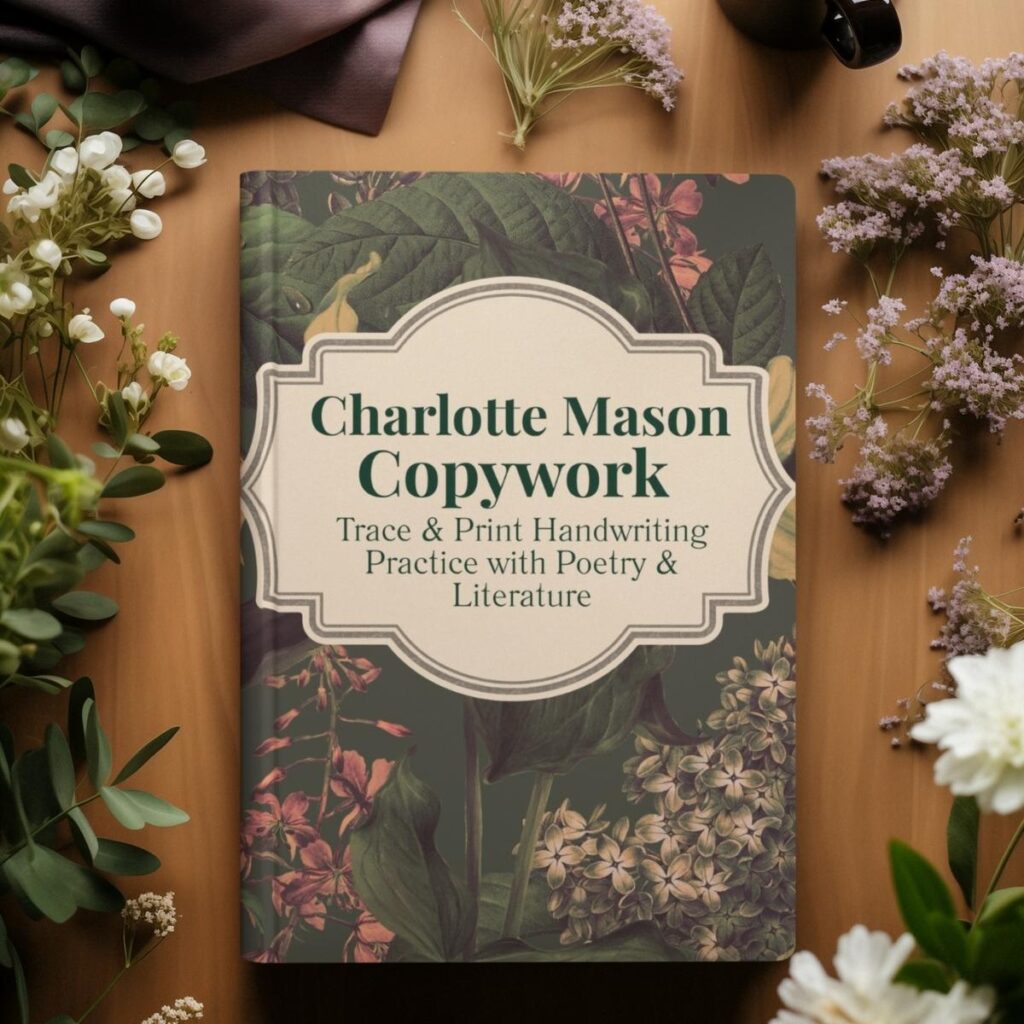
The Charlotte Mason Cursive Copywork Workbook
I created this workbook for families making the print-to-cursive transition who want passages worth reading rather than busywork sentences. My son Neven does the print copywork daily and loves it. The cursive workbook is what comes next, built on the same structure, so the content and approach feel continuous.
The Charlotte Mason Cursive Copywork workbook opens with prewriting warm-up strokes for cursive formation, moves through uppercase and lowercase letter practice with trace-and-copy pages, and then transitions into poetry and literary passages from authors worth spending time with: Robert Louis Stevenson, Christina Rossetti, Shakespeare, Tennyson, A.A. Milne, and others.
The tracing is optional. Families who prefer to go straight to copying from a model can do that. The passages are also well-suited to dictation as the child advances, so the book stays useful longer than you might expect. It is designed for ages 7 to 10, and for older children who are coming to cursive later or strengthening existing habits.
What Script Did Charlotte Mason Actually Recommend?
For those who want to go deeper: Mason did not recommend standard looped cursive. She recommended one script for use from grade 1 through 9 in her PNEU schools: the italic style laid out in A New Handwriting for Teachers by Monica Bridges, published in 1898.
Mason described it in Home Education (p. 236-238): “The distinctly commonplace writing taught from existing copy-books, however painstaking and legible, cannot but have a rather vulgarising effect both on the writer and the reader of such manuscript.” The Bridges script, she wrote, produces writing “pleasant to acquire because it is beautiful to behold. It is surprising how quickly young children, even those already confirmed in ‘ugly’ writing, take to this new handwriting.”
The Bridges italic is a joined cursive script rooted in 16th-century Italian calligraphy: upright, not heavily sloped, with none of the exaggerated loops of traditional American cursive. It was intended as a single script from the beginning, not a print stage followed by a separate cursive stage. The modern CM community has largely interpreted programs like Getty-Dubay Italic as the closest contemporary equivalent.
Most families today, including ours, use modern cursive rather than italic. That is a reasonable and practical choice, and it does not diminish the copywork method in the slightest.
Cursive is worth teaching well. Whatever script or sequence you use, the things that make it work are the same things Mason identified over a century ago: short lessons, careful work, a good model, and something beautiful to copy.