Catholic Copywork: Why We Copy Prayers by Hand

As a classical homeschooling mom who values great books, beautiful writing, and the intentional formation of my children, copywork is a daily part of our school day and one of the best things I have borrowed from Charlotte Mason.
We are a Catholic family. Prayer is part of our days in the ordinary way: morning prayers, grace before meals, the Rosary, night prayers with the boys. When my children begin copywork, the prayers of the Church are copied alongside the poetry and the great works of literature.

Save This Page
What Is Copywork?
A child copies a passage of well chosen text by hand. A sentence, a verse, a short prayer. Charlotte Mason called it transcription and recommended it from ages 7 or 8, though many families, including ours, start earlier. It builds handwriting, spelling, and grammar all at once, and what gets copied carefully tends to get remembered. For the full picture on the method, start with Charlotte Mason Copywork: What It Is and Why It Works.
The Tradition Behind It
Catholics have been copying sacred text by hand for thousands of years.
Medieval monks spent their lives in the scriptorium copying Scripture and sacred texts. Cassiodorus, the sixth century monk who founded the Vivarium monastery, declared that “every work of the Lord written by the scribe is a wound inflicted on Satan.” Copying was not mere labour for these men. It was devotional work, slow and deliberate, requiring sustained attention to every word on the page.
In Celtic monastic schools, students began with a stylus on wax tablets, copying texts as part of their basic formation. Writing and learning were not separated. The hand and the mind worked together, and what passed through the hand went somewhere different than what was only heard or read.
This is also deeply classical. The classical tradition has always understood that imitation is formation: you become, in part, what you spend your time copying. Roman students copied Cicero and Virgil. Christian students copied Scripture and the prayers of the Church as their earliest instruction.
Why Copying Prayers Works
The Church has handed on her prayers orally for centuries, and there is real value in a child who knows the Our Father cold, without hesitation. But copying does something recitation alone does not.
When a child copies the Hail Mary, he has to look at every word. He cannot rush or half-attend. He is moving through the prayer slowly, one letter at a time, noticing the spelling, the punctuation, the way the sentences sit. He has to be present to it in a way that recitation does not require.
Charlotte Mason called transcription (copywork) “slow and beautiful work” for a reason. Classical education knew this too, which is why copying was used to transmit everything worth transmitting, prayers and Scripture, and great works alike, not just as a handwriting exercise but as a method of formation.
A child who copies the Act of Contrition is not just practicing penmanship. He is spending slow, focused time with words that are meant to shape him. That is exactly what copywork is for.
How We Do It
We start our homeschool day with prayer: first in English, then the same prayer is said in Latin. Copywork follows directly from that. My sons don’t begin any formal Latin instruction until they’re 7, so we follow the early classical practice of copywork which took place in the home.
I started copywork earlier than Charlotte Mason recommends. My son began at 5, and for the first half of the year, our sessions looked like this:
- Three days a week
- Trace then copy one uppercase letter, then one lowercase letter
- One single line of copywork from the workbook
- Five to ten minutes total
In the second half of the year, we moved to daily copywork and gradually increased the number of lines as his hand and attention grew stronger. Some days we do prayer copywork, other days poetry or a literary passage.
If you are structuring your own days, older children or those with solid letter formation can work at a fuller pace:
- Daily copywork
- Skip the individual letter practice if formation is already solid
- Two to three lines or more per session
- Work up gradually as fluency improves
Whatever the age, the standard stays the same: the work should match the model, and if it does not, the child tries again.
What Is in the Workbook
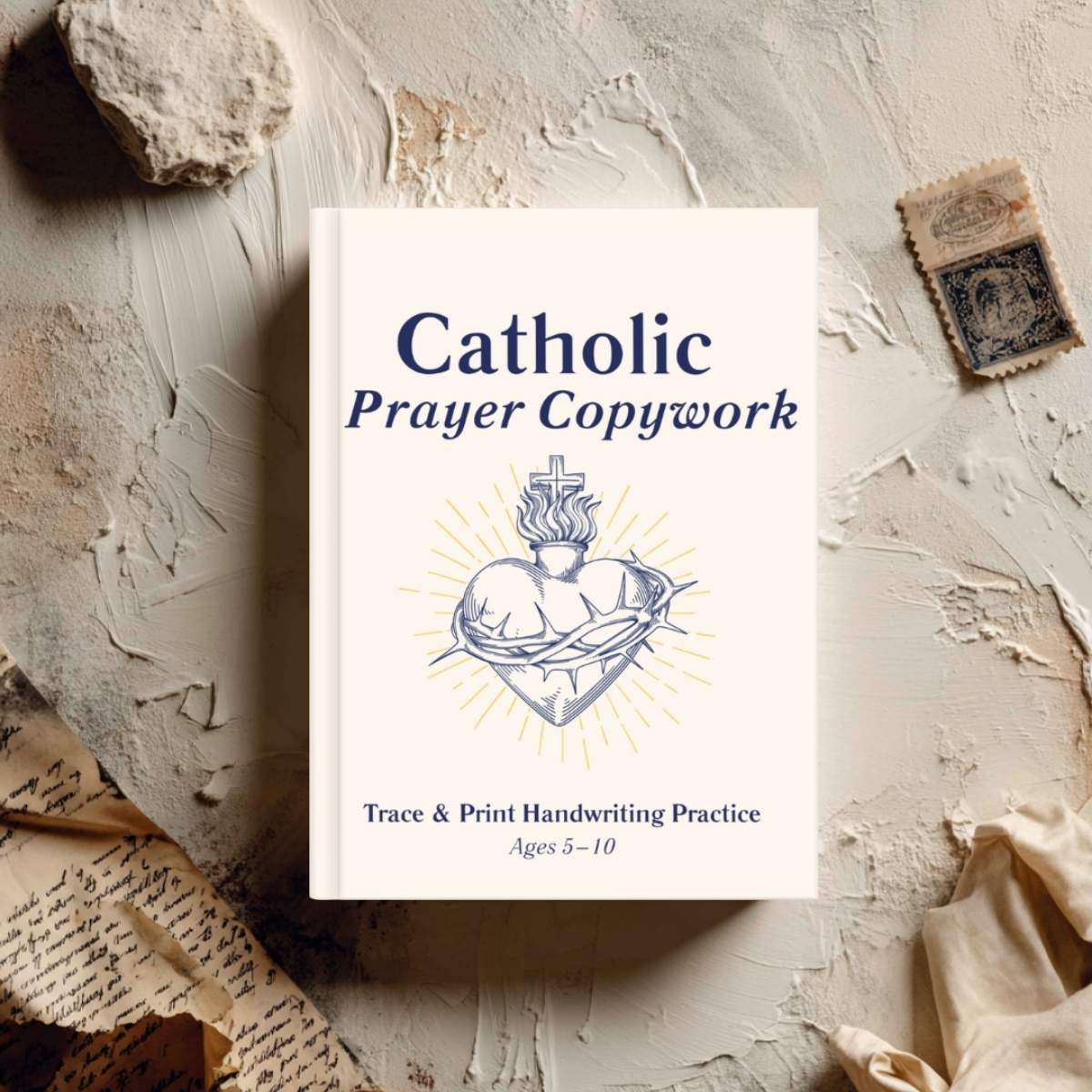
The Catholic Prayers Copywork workbook presents each prayer for tracing first, followed by a lined page for independent copying, with large beginner-friendly lines designed for children ages about 5 or 6 to 10, calm and uncluttered, and focused on the words themselves.
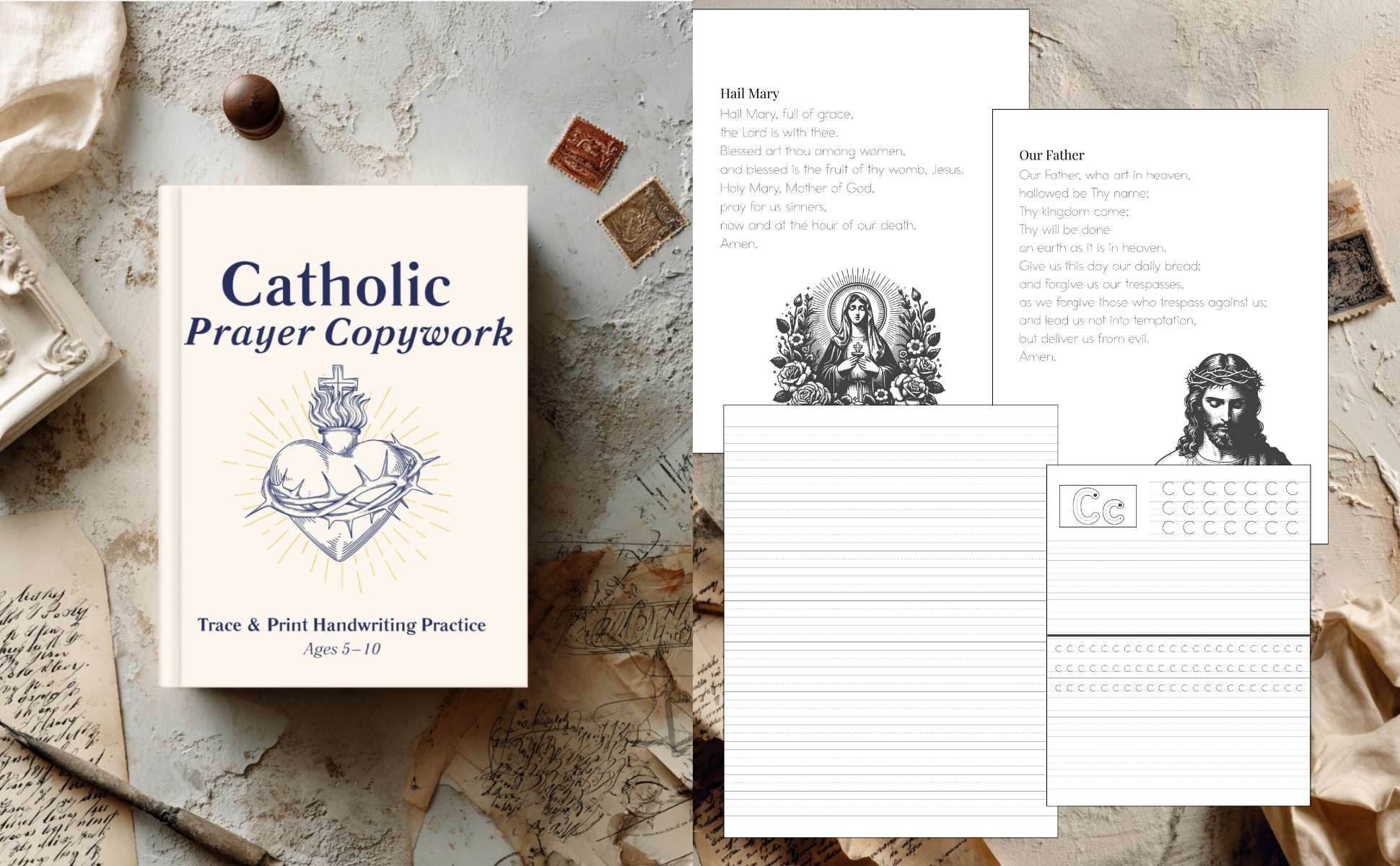
Inside, children will find the Our Father, Hail Mary, Glory Be, Apostles Creed, Act of Contrition, Memorare, Saint Michael Prayer, Fatima Prayer, Magnificat, and more, alongside alphabet practice for letter formation.
It is designed for Catholic homeschool families, religious education, and daily handwriting practice, and works just as well in a classroom or CCD setting as it does at home.
I have a growing collection of copywork workbooks for different ages and purposes. You can find them all below.