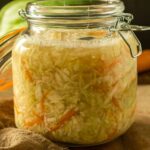
Traditional European Sauerkraut
My recipe for homemade sauerkraut follows the authentic European tradition and provides an easy recipe to make at home in jars or crocks.
Servings: 20
Calories: 28kcal
Equipment
- Mason Jars or Fermentation Crocks You need a lid or other type of cover to prevent dust, dirt, and insects from entering.
- Chef's knife or cabbage slicer
- Fermentation weights Either specialty fermentation weights, crock weights, or a ziplock bag full of water or brine.
- Wooden pounder or mallet Or just use a wooden spoon.
- Digital scale Highly recommended that you weigh your ingredients.
Ingredients
- 5 lbs cabbage Thinly and finely shredded. While any type of cabbage can be used, fresh fall cabbage (within two days of being picked) is always best.
- 3 tablespoons fine sea salt Double the amount for coarse salt, do not use iodized salt. Or 45 grams for the recipe amount of cabbage if using a scale (recommended).
Instructions
- Remove the outer leaves from your cabbage. Cabbage does not need to be washed.
- Slice the cabbage head in half and remove the tough inner core. Compost the outer leaves and inner core.
- Using a sharp knife or cabbage slicer, slice the cabbage very thin and fine, as thinly as possible.
- Weigh the cabbage until you reach 5 lbs or the desired amount that you are making for yourself.
- Add the salt and massage it into the shredded cabbage until coated. Cover the bowl and leave it alone for about an hour.
- After the hour has passed, place your shredded cabbage into the fermentation crock or mason jars and start pounding the cabbage for about 15-20 minutes or until all the water has been released from the cabbage and it is submerged by about 1/2 an inch of liquid.
- If the cabbage is older and dry, there may not be enough brine released to submerge it, so dissolve 1.5 teaspoons of fine salt per 1 cup of water. Double that amount for coarse salt.
- Add your weight of choice to the jar or crock to keep everything fully under water for the entire time of fermentation.
- Cover jar or crock and leave it somewhere cool and dark (like your pantry or basement) to ferment. Taste it after two weeks and let it keep fermenting for as many as 8 weeks until a pleasantly sour and salty sauerkraut is achieved. Store in cold root cellar or refrigerator afterwards indefininetly.
- Double this recipe up as required and add any other ingredients you wish as per the notes.
- Weighing your cabbage is the best way to achieve great and consistent results that are not too salty. The fermentation ratio I use is 2.00% weight of salt to weight of cabbage. So 5 lbs of cabbage is 2268 grams, which means the calculation is 2,268 multiplied by .020 for a total of 45 grams of salt.
Notes
Once your sauerkraut is fermented to your desired level of sourness after 3-8 weeks, it is easy to place it in the refrigerator or your cold room or cellar, where the temperatures will halt fermentation. Enjoy your sauerkraut for many, many months raw and in recipes.
If using a large fermentation crock, you can transfer the contents to smaller jars to make it easier.
Hint: Make multiple small mason jars of sauerkraut with different additions of spices, herbs, and vegetables to have a wide variety of tastes and flavors all winter. We have a big family-sized fermentation crock (up to 20 heads of cabbage) and use it for plain, simple kraut, but I'll also keep smaller jars of different flavors.
Let's get on to extra and optional additional ingredients and flavor pairings.
- Caraway Seeds | Traditional German sauerkraut frequently contains caraway seeds. Add 1 to 1.5 teaspoons per pound of cabbage if using.
- Juniper Berries | Another German staple frequently paired with cabbage recipes, sauerkraut, meats, and more. They can be expensive to buy but are easy to forage pretty much year-round. Add ½ to 1 teaspoon per pound of cabbage if using.
- Fresh Ginger | Fresh ginger adds so much flavor to sauerkraut! Add a finely diced or minced 1-inch piece of ginger per 1 pound of cabbage.
- Apples | Cut an apple into matchsticks and add them to sauerkraut. ½ of an apple per 1 pound of cabbage and any variety you have works. My Slovak mother-in-law remembers doing this in childhood when her family would make huge crocks of sauerkraut to last the winter.
- Carrots | Finely shredded carrots add sweetness and color to sauerkraut. You can see I'm using carrots in one of my jars in the photos. Use 1 medium carrot or more per pound of cabbage.
- Beets | Beets will add sweetness, earthiness, and color your sauerkraut pink. Add ½ of a medium shredded beet per pound of cabbage.
- Root Vegetables | spice radishes, sweet parsnips, and more — all can be added to sauerkraut. Start with a small amount and consider making multiple small mason jars of kraut where you can experiment with flavors.
- Hot Peppers | Like it hot? Add a single hot pepper per jar of sauerkraut for some flavor and spice. Jalapeno peppers are a popular choice.
- Fresh Herbs | bay leaf, dill, lovage, and more — add some to your kraut — just keep it submerged below he brine to avoid mold and spoiling.
- Ginger, carrot + beet.
- Apple, carrot, ginger + beet.
- Ginger + hot pepper.
- Ginger + Lemon peel + beet.
Nutrition
Calories: 28kcal | Carbohydrates: 7g | Protein: 1g | Fat: 0.1g | Saturated Fat: 0.04g | Polyunsaturated Fat: 0.02g | Monounsaturated Fat: 0.02g | Sodium: 1067mg | Potassium: 193mg | Fiber: 3g | Sugar: 4g | Vitamin A: 111IU | Vitamin C: 42mg | Calcium: 46mg | Iron: 1mg
